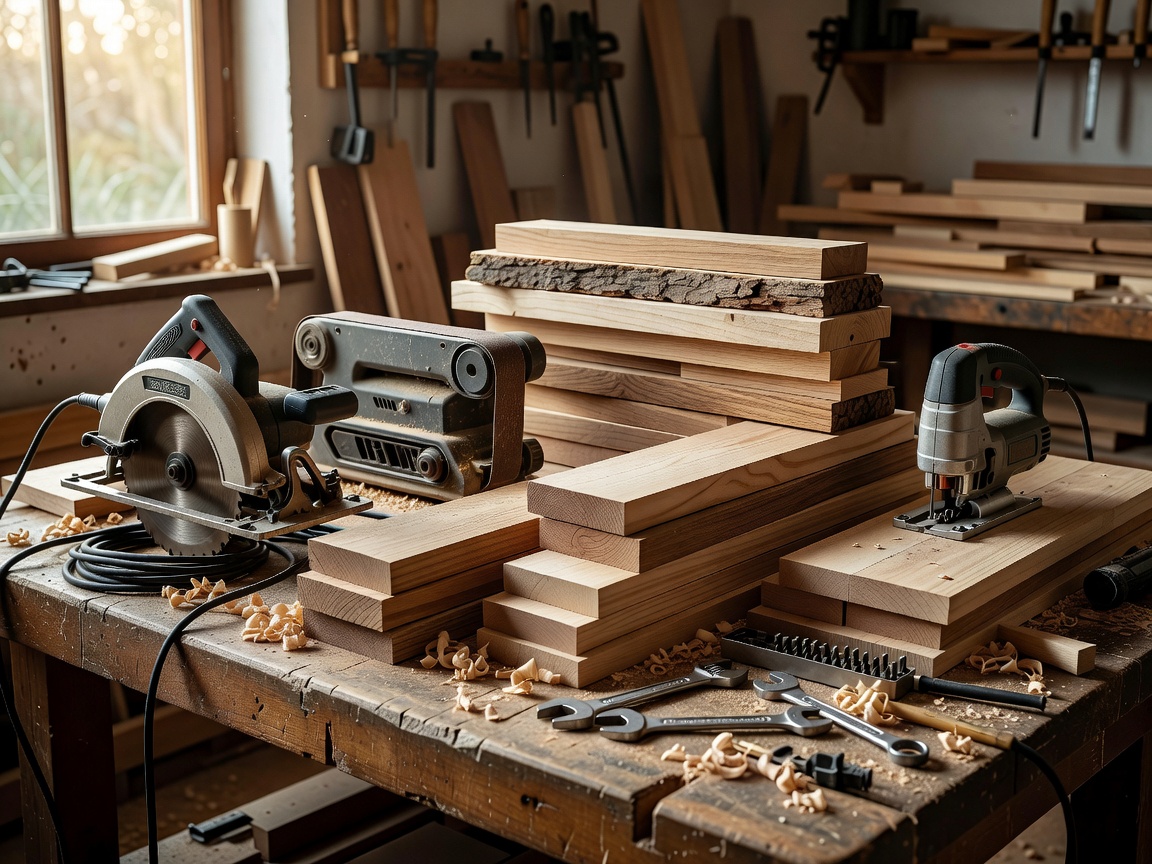
Buy around your actual stock and projects
A drill or drill-driver is often the first useful powered purchase because it bores holes, drives fasteners and supports simple jigs. Battery voltage alone does not define performance. Chuck quality, low-speed control, clutch behaviour, balance and access to compatible batteries matter in daily use.
Before choosing a larger machine, list the dimensions and materials you commonly handle. Sheet goods demand a different workflow from short solid-wood parts. Include blades, bits, guides, extraction adapters and safe material support when comparing cost and workshop space.
Match the saw to the direction of work
A handheld circular saw is versatile for rough breakdown and accurate guided cuts. A track saw adds guided plunge action and splinter control, making it particularly useful for panels. A mitre saw is efficient for repeated crosscuts, while a table saw excels at repeatable ripping and jig-based work.
A table saw requires suitable guarding, a riving knife, stable support and careful training. Never make a freehand table-saw cut. Use a fence or guided fixture, keep hands clear of the blade path and avoid trapping narrow offcuts between a fence and a crosscut workpiece.
| Saw type | Best suited to | Main trade-off |
|---|---|---|
| Circular saw | Portable breakdown and general cuts | Depends on guides and stable support |
| Track saw | Clean guided cuts in panels | Track length and accessory cost |
| Mitre saw | Fast repeated crosscuts | Limited ripping ability and large operating space |
| Table saw | Repeatable ripping and fixture work | Space, extraction and training requirements |
Routers and sanders need controlled removal
A compact router suits light edge work and small templates. A larger plunge router provides greater cutter capacity and controlled depth for grooves and mortises. Make deep profiles in several passes, use cutters compatible with the collet and follow the cutter maker’s speed limits.
Random-orbit sanders remove marks efficiently while limiting directional scratches. Belt sanders remove material aggressively and can quickly create hollows. Progress through abrasive grits without large jumps and connect compatible extraction whenever possible.
Extraction and inspection are part of the purchase
Fine wood dust is a health hazard. Capture dust at the source, wear suitable respiratory protection when exposure remains possible and maintain clean filters. A workshop vacuum suits many handheld tools; large chip-producing machines may need a higher-volume collector.
Keep eye and hearing protection accessible. Inspect cables, batteries, guards, cutters and work supports before use, and disconnect power before changing blades or servicing a cutting area. A machine that holds its settings and accepts practical extraction fittings is more valuable than one with impressive specifications but awkward controls.